We Need to Stop Talking About 'Safe Space'

The Hearts and Minds Partnership is delighted to share a blog piece written by Alex Paterson, one of our EDEI Root Makers - a dynamic and diverse team of brilliant people from our sector who are helping the Hearts & Minds Partnership to connect, grow and empower a more inclusive grassroots perinatal mental health community nationally.

Alex is an Infant Mental Health and LGBTQ+ Families Advocate and has been key in supporting many areas of our work. Most recently, he has devised, created and presented a new module on our free training platform, Smart Space, called 'Making Roots'.

Making Roots is all about achieving depth of practice when running a VCSE in perinatal mental health in terms of Equity, Diversity, Equality and Inclusion. Within this module, Alex explores how to create welcoming, equitable environments for diverse families from their first touchpoint through to ongoing engagement. It's more complex than you think, and begs the question of what a 'safe space' really is . . .
We all have an unpopular opinion don’t we? Would you like to hear one of mine? I don’t like the phrase ‘Safe Space’. Not because I object to the idea of being safe in any way, of course not, but I have a number of issues with the phrase that means my heart sinks a little every time I hear someone use it.
Every so often… when I decide I feel safe to do so… I’ve gently objected to it being used and explained why I feel the way I do. As with any viewpoint that goes against the established order, I often feel like I’m just calling into the wind. So, it was a pleasant surprise that at our Strengthening The Roots event in May 2025, Ruth Williams from Smile Group told me she’d taken up my private bugbear and persuaded a local partner to change how they describe their services. It seemed worth putting this in writing.
What do we mean by 'Safe Space'?
The academic Moira Kenney wrote that the phrase started to be used on a regular basis on the Los Angeles gay scene of the 1960s*. 'Safe Space' meant gay and lesbian bars where people could freely express themselves without fear of physical harassment. Crucially though, the promise of safety was always limited, no one could guarantee a space would not get raided by the police.
Fast forward sixty years and we are in a very different place. In this context, when perinatal mental health services talk about Safe Space, we are often taking physical safety for granted. We now most often use the phrase to indicate that parents are free to share their problems and feelings. It’s become shorthand for telling parents a space has therapeutic or community-building intent, that we approach them with compassion and no one will judge them.
*Mapping Gay L.A., Moira Kenney, 2001

Why is 'Safe Space' a problem?
In my early career I ran parent drop-in groups within Children’s Centres. Our most popular, a Wednesday drop-in, was a raucous mix of Play-Doh, sleeping bunnies and community bonding, regularly bringing together university academics, refugees, hospital consultants and those in emergency temporary accommodation, in a shared experience of sleepless nights, weaning and tantrums.

One occasion sticks in my mind. A single mum, who had come to the UK as a refugee, had a new baby and an energetic two year old in tow. At the end of one session I noticed she’d waited behind. I went over and realised she was crying. Another parent had whispered into her ear during the group: ‘Can’t you control your fucking child?’
I felt like I’d been punched in the gut, and I imagine she felt the same. The other parent denied it, and despite our best efforts I don’t think either parent felt fully safe afterwards.
Our control as service-providers, whether we are running play-drops, peer support groups or therapeutic interventions, is never complete. We don’t know the views and experience of every parent we work with, nor would it be healthy to try. Nor do we ever fully know how fellow team members might respond to new situations, meeting a trans dad for the first time, or working with a mum who’s had postnatal psychosis. Simply declaring a space safe doesn’t mean it is.
What does this mean in practice?
First, we need to stop presenting safety as a static status. Every time a new person comes into your service they re-open the question of safety, not only asking, ‘Is this space safe for me?’ but also, ‘Am I safe for everyone else?’ We need to embrace safety as a continual process, integrating conversations about it into our working practices until they become routine, whether that’s in audits, training, or supervision.
Secondly, the phrase, Safe Space presents safety as an absolute concept, a final destination. Have you ever heard someone say to a parent on a first session something like, ‘It’s ok, this is a Safe Space. You can be yourself here.’' I certainly have. The good intentions are clear, everyone in that situation wants the same thing, but it still needs calling out. For a parent with trauma of any kind, safety is a complex feeling; their body can be fight or flight at small or unexpected things. Telling them something is safe, rather than letting them decide for themselves, can actually be an added burden. Most parents will want to please us, and may find themselves agreeing that they feel safe even when they don’t. We need to recognise that safety is subjective, and allow parents the autonomy to say for themselves, ‘I’ll decide what feels safe for me’.
Last year I ran an infant massage course for a small group of parents. More by chance than intention, three of the four mums attending were in same-sex marriages (I live in Brighton). For the first half of the course the parents were often shy around each other. Through conversations about ordinary things, sleep, weaning, they slowly started to trust each other on a deeper level.

One of the genius things about the International Association of Infant Massage’s model for infant massage, is the way it nurtures peer support through the careful facilitation of conversations. In a later session we spoke about journeys to starting a family. It was at this moment that the one parent in an opposite-sex marriage came forward and shared that she, like everyone else in the room, had been through IVF. She felt able to be vulnerable. I never told the group it was a Safe Space. I’d let them decide that for themselves.
Moving towards 'Safer Spaces'
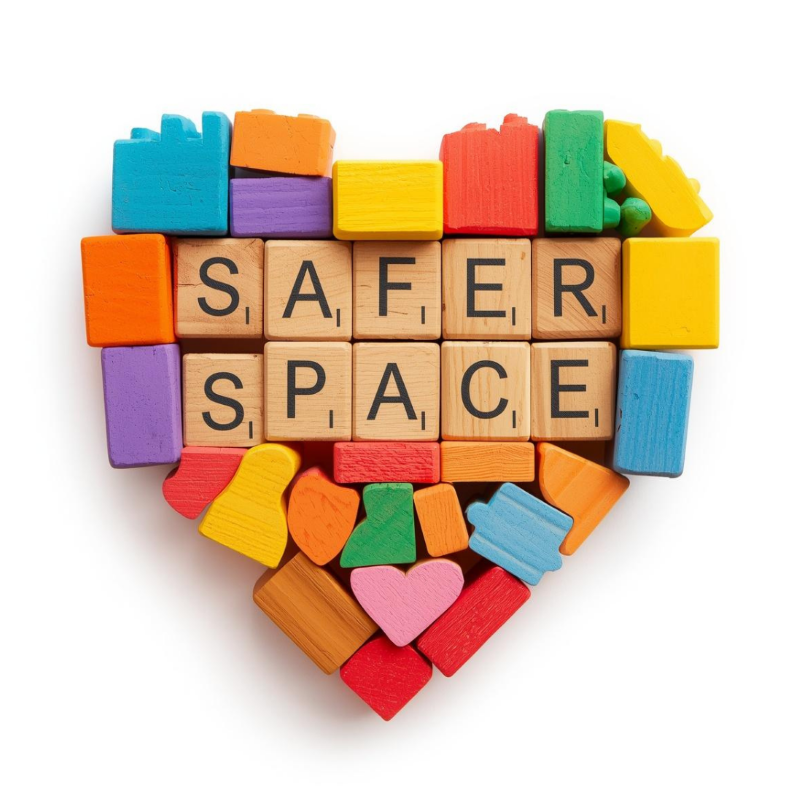
So, here’s what I suggest: we need to stop talking about Safe Spaces and talk about 'Safer Spaces' instead. Safety needs to be a verb, not a noun. Promising someone a safe space isn’t just an over promise, but it may not even be an active one. When safety is treated as a noun, it's viewed as a fixed destination we have arrived at, a completed checklist and a set of arbitrary rules that should fit everybody’s needs.
Rather than offering parents a promise of safety, we need to offer them a partnership of safety, a shared commitment to an ongoing process where everyone, adult, child and worker, feels safe, whatever that means to them. I would argue that safeguarding and equalities practice are symbiotic: you can’t have one without the other.
Safety needs to be an ongoing activity that everyone continuously practises, commits to developing and updates as needed. It needs to embody a set of dynamic behaviours that respond to the changing needs of the moment, whilst recognising that 'Safe' means something different for each individual.
It needs to be something we actively do rather than passively possess. We need to strive for services where we say to parents, ‘It’s ok, we want this to be a Safer Space. We hope you can be yourself here.’
This is exactly what the new Making Roots module on the Hearts & Minds Partnership's Smart Space platform is designed to support. Making Roots isn't about policies sitting on shelves, it's about the living, breathing practice of embedding inclusion and equity into grassroots perinatal mental health work. It will take you through the theory, help you think about how you welcome families, support you through difficult conversations, and help you embed EDEI into how your organisation actually works.
Because if we're serious about safer spaces, we need to do the work - together.

A huge thank you to Alex for writing this thought-provoking piece for the grass roots perinatal mental health community. If you'd like to contact Alex or Hearts & Minds, please make your initial contact through: hello@heartsandmindspartnership.org
If you'd like to hear more from Alex on EDEI embedded as a living, breathing value throughout YOUR perinatal mental health service (including Safer Spaces), then you can find out more or sign up to Smart Space here.